Game hot

Box 1 Image 1 Box 1 Image 2 Box 1 Image 3
Box 2 Image1 Box 2 Image 2 Box 2 Image 3
Box 3 Image 1 Box 3 Image 2 Box 3 Image 3
Box 4 Image 1 Box 4 Image 2 Box 4 Image 3
Box 5 Image 1 Box 5 Image 2 Box 5 Image 3

Thursday, August 19, 2010

The Iterative Web App: New Stacked Cards Interface for Gmail on iPad.

In April 2009, we announced a new version of Gmail for mobile for iOS and Android. Among the improvements was a complete redesign of the web application's underlying code, which allows us to more rapidly develop and release new features that users have been asking for, as explained in our first post. Today’s topic for the The Iterative Web App, a series where we continue to release features for Gmail for mobile, is the Stacked Cards Interface on the iPad.

When we announced our new interface for Gmail on the iPad, we requested feedback on how we could improve this experience for tablet devices. In June, we responded with a new compose screen. Today, we’re addressing the top feedback by launching a new “stacked card” interface for selecting and managing multiple conversations.


In the past, performing actions on selected conversations was awkward. There were two similar toolbars on the screen: one on the bottom left and the other on the top right. The former affected the selected conversations, while the latter affected the currently open conversation. Since the toolbars’ buttons looked similar, it was easy to mistakenly use the wrong toolbar. Sound confusing? It was.

In the new interface, selected conversations are displayed stacked on the right panel for easy organizing, archiving or deleting. The second toolbar is gone so it’s always clear which conversations you’re working with.

This new interface has also been an opportunity for our team to experiment with CSS3 transitions, which give mobile web applications a similar look and feel to native applications. More details on the implementation are posted on the code blog.

To try the Gmail webapp on the iPad, just go to gmail.com in Safari. For quick access, create a homescreen link. Please note that the new interface is only available in US English for now.

Friday, August 13, 2010

Just speak it: introducing Voice Actions for Android


Our mobile phones have become modern-day Swiss Army knives. An Android phone is a handheld computer, a music player, a notepad, a GPS navigation unit and more, all rolled into one sleek device that fits in your pocket. Today’s phones do so many things for us that sometimes we don’t even think about how we do them.

Even though our phones do all these new things, the most natural way of interacting with a phone remains what it always has been: speaking. And to that end, we’re pleased to introduce Voice Actions for Android. Voice Actions are a series of spoken commands that let you control your phone using your voice. Call businesses and contacts, send texts and email, listen to music, browse the web, and complete common tasks, all just by speaking into your phone.

To use Voice Actions, tap the microphone button on the Google search box on your home screen, or press down for a few seconds on the physical search button on your phone to activate the “Speak Now” screen. Let Mike LeBeau, the lead engineer for Voice Actions, show you in this video.


Speak any of these commands to perform a Voice Action on your phone:
  • send text to [contact] [message]
  • listen to [artist/song/album]
  • call [business]
  • call [contact]
  • send email to [contact] [message]
  • go to [website]
  • note to self [note]
  • navigate to [location/business name]
  • directions to [location/business name]
  • map of [location]
And of course, you can still conduct a Google search using your voice.


While we’re at it, we’re also releasing an updated version of the Google search widget for Android. When you type a local search query, like [italian restaurants] you’ll see suggested restaurants with addresses and ratings. Also, as you type queries, you can refine them further by tapping the pencil icon that appears to the right of search suggestions.

Both Voice Actions and the new Google search widget require Android 2.2 (Froyo), and will be pre-installed with the new Droid 2 phone from Motorola and Verizon. Voice Actions are currently available for U.S. English speakers.

If you have another phone with Android 2.2 (like the Nexus One, HTC Evo or the original Droid), you’ll need to download several app updates from Android Market to get all the latest goodness:
  • Voice Search (this app includes Voice Actions)
  • Google Search widget
  • music apps (e.g. Pandora, Last.fm, Rdio, mSpot)
To get started fast, scan the QR codes for these apps below.

We think Voice Actions help you get things done on your phone faster and easier. Give it a try, and let us know what you think!

Voice SearchSearch widget

Instantly zap links, maps and phone numbers to your Android phone with Chrome to Phone!

(Cross-posted from the Google Chrome blog.)

Ever wanted a way to quickly and easily send links and other information from your desktop or laptop to your phone to view on the go? The new
Chrome to Phone extension adds a button to your Google Chrome browser that instantly sends the current web page, map, YouTube video, or selected phone number or text to your Android device running Froyo (or Android 2.2).

Suppose you're reading an interesting article on your favorite news website and need to leave for an urgent appointment. Simply click the extension icon in your browser to send the link to your phone and the device's browser will automatically open the link, ready for you to view on the go. Chrome to Phone also works seamlessly with Google Maps. Say you’ve looked up an address or driving directions on your desktop. Clicking the extension icon in your browser will push the information to the Google Maps app on your phone. YouTube videos work the same way with the extension. You can also select a phone number on a web page and send it to the dialer on your phone. Selected text can also be automatically copied from your browser and sent to your Android clipboard for later viewing.


The Chrome to Phone extension is available in English for now, but we hope to expand to other languages soon. Check out the help center if you have further questions. To get Chrome to Phone, install the extension in your Google Chrome browser and the Android application on your phone from Android Market, and you’re ready to go.

Posted by Dave Burke, Engineering Manager

Thursday, August 12, 2010

Flipping for Gesture Search

You may already be familiar with Gesture Search, our Android app from Google Labs that lets you search by writing out characters on the touchscreen of your device. Today we’re happy to announce a new version, Gesture Search 1.2, which includes a new motion gesture. By doing a “double flip”, or flipping your phone away and then back, you can start Gesture Search at any time. This eliminates the need to activate Gesture Search from a home screen shortcut. You can turn the feature on or adjust its sensitivity in Settings. We’ve also fixed some bugs and improved usability by adding accessibility support. Gesture Search is still in its early stages (as with all things in Google Labs) but we’d love to hear your feedback in the comments below. It is available for Android-powered devices running Android 1.6 and above, and can be downloaded in Android Market.


Update 8/11/10: If you're on an Android-powered device, click here to download Gesture Search. If you're on a computer, go here.

Update 8/19/10: An updated version of Gesture Search has been posted to Android Market, which contains some bug fixes. You can learn more about the double flip update here.

Posted by Yang Li, Research Scientist, Gesture Search team

Wednesday, August 4, 2010

Introducing the new Search History link on Google

Have you ever tried to remember how to get back to a website that you found from a recent search? Today in the US, we’re launching a new search history feature which helps you quickly get back to sites you've been to and see items you have starred from your Android, iPhone, or desktop searches. Just sign in and then tap the history link at the bottom of the Google homepage.
If you’ve enabled search history in your account (tap “Settings” and select “Save Searches” under “Search History”, then tap “Save”), the history that you see is a combination of all your searches done while you are signed-in, whether you are searching from a laptop at home, your desktop computer at work, or your phone while on-the-go. Your mobile searches are marked with a little phone icon so you can tell them apart. For websites you’ve visited while searching on a desktop or laptop, you’ll see screenshot thumbnails that can help you recognize and return to the right sites quickly.
If you want to remove any history items, you can tap the "Edit" button at the top of the page and delete individual search queries. If you prefer to stop recording search history all together, choose the “Do not save searches” option under "Settings" on the home screen and tap “Save.”

At the top of the History page, you can also select your “Starred items,” which shows a list of search results you’ve starred on your computer or phone. Let’s say after researching places to snorkel in Hawaii, you found a website full of photos about Kealakekua Bay that you want to return to later. To star the Kealakekua Bay website, simply click on the star next to the Kealakekua Bay website on Google search results. Thereafter, whenever you want to return to the site, simply click on the “Starred items” option in history. This way, while you’re out with friends, you can easily get back to the website and show pictures of this magical cove right from your phone.
We hope you find the new History link useful!

Tuesday, July 27, 2010

An Even Better Way to Find Places Nearby

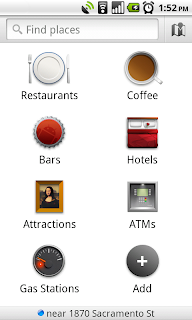
With six updates in six months, Google Maps for Android has been getting plenty of new features, both big and small. A continued focus with each update has been on giving you better ways to find places nearby. In the most recent updates, Maps has gotten features like swiping between search results and info like photos, reviews, and more helpful content on the result pages. With today’s launch of Google Maps for mobile 4.4, we’re introducing an even easier way to find places around you: a dedicated Places icon that lets you quickly look up nearby places and pick a place to go using updated Place Pages, just like on your computer.

On Android-powered phones with Google Maps 4.4, you’ll find the new Places icon in the app launcher with the rest of your apps. Press and drag it right onto your home screen to use it when you’re looking for a restaurant, shoe store, movie theater or any other type of local business. You'll get a detailed list of all the nearest places and can choose one to learn more about it on its Place Page.


Search for several convenient types of places with the default categories or add your own for your most frequent searches. You can also use the search bar at the top to type or speak any query. I tend to use the “coffee” search a lot, but I’ve also looked for “gas stations” on the road, “ice cream shops” in my neighborhood, and even specific places like “Chelsea Market” on a recent trip to New York.

Of course, you’ll often want to learn more before deciding where to go. With updated Place Pages, you should be able to find all you need to know about a place, whether you’re wandering into a new restaurant or deciding from your couch. In addition to photos and reviews, Place Pages now have a bunch of new details, such as prices, parking and menu links to inform your quest for the perfect steak. You'll also notice that the search results list now highlights business opening hours in addition to compass direction and distance -- consider it your late night caffeine radar.


Google Maps for mobile 4.4 is available now for Android 1.6 and above. Just search for Google Maps in Market or tap here from your phone. The Place Page and search result updates are coming soon for BlackBerry users so keep an eye out for an update at m.google.com/maps (from your BlackBerry Browser) or on our Twitter and Facebook pages.

Visit our Help Center to learn more, ask questions in our Help Forum, or give us suggestions and vote on other people’s on the Mobile Product Ideas page.

Update: Google Maps for BlackBerry version 4.4 is now available with the new search results view and Place Page details. From your BlackBerry's Browser, go to m.google.com/maps to install it now.