Game hot

Box 1 Image 1 Box 1 Image 2 Box 1 Image 3
Box 2 Image1 Box 2 Image 2 Box 2 Image 3
Box 3 Image 1 Box 3 Image 2 Box 3 Image 3
Box 4 Image 1 Box 4 Image 2 Box 4 Image 3
Box 5 Image 1 Box 5 Image 2 Box 5 Image 3

Tuesday, November 8, 2011

Google Catalogs: More brands, more categories, more fun


Since our launch in August, we’ve been hard at work to bring more great content to Google Catalogs. Today we're excited to announce that we’ve doubled our collection of catalogs to include more than 100 brands and 300 individual issues from the catalogs you love, like Williams-Sonoma, Sephora and Nordstrom.

Thanks to our ever-growing list of partners, we’ve expanded the app to include six new catalog categories for you to shop. Love gadgets or the great outdoors? Looking for that perfect holiday treat to send to a friend? Well, look no further than our newly launched catalogs and categories:

Google Catalogs lets you create a collage of your favorite items from across many catalogs. You can even share your collages with friends and family - a visual way to show them what’s on your list this holiday season!

We’ve also added a number of great brands to our existing categories, including: Barneys, Tory Burch and Trina Turk (Fashion & Apparel); BeautyBar (Beauty); Blu Dot, FLOR, and Ballard Designs (Home); Hanna Andersson, CWDkids, and Serena & Lily (Kids); and Garnet Hill, Uncommon Goods, and Wine Enthusiast (Gifts).

In the mood to kick off your holiday shopping? Visit the App Store to download the free Google Catalogs app for iPad.

Friday, November 4, 2011

BlogWorld 2011: We’ll see you in LA!

Update: For those of you who can’t attend the conference, we’ve added a schedule of Google+ Hangouts below.

It’s not often that we get to meet up with Bloggers in person, so we’re very excited to invite you to join us next Thursday, November 3rd, when a bunch of Blogger team members head to Los Angeles to attend the
2011 BlogWorld Expo.


To kick things off on Thursday, Jennifer Bahk from the Google Adsense team will be hosting a session called “Get More Bang and Make More Bucks with Blogger” at 3:45PM, where she’ll share expert advice on how to optimize your blog to make money with AdSense.

On Friday and Saturday, the team will be hanging out at booth 314 on the exhibition floor, where we’ll be giving live demos, answering questions, and giving away Blogger swag, including photo printouts from our very own Google Photobooth. And for those of you who are traveling from abroad, Sabine Borsay, our Consumer Experience Specialist from Europe, will also be in attendance to chat with international bloggers about your blogging experience and needs.

From 1-3PM on Saturday we’re hosting a meet-and-greet at our booth with Ari Seth Cohen, a fashion blogger from New York City whose blog, Advanced Style, has inspired a book that will be debuting in 2012. Come by to say hello to Ari and hear the story of how he took blogging from a hobby to a successful, sustainable business.

It’ll be an action-packed few days, so if you’re interested in attending, as a member of the Blogger community you can use this special code for 20% off of any registration package at BlogWorld 2011: BLOGGER20.

If you can’t attend the event, our Community Manager, Lisa Ding, will be hosting a series of video chats with Google+ Hangouts on her Google+ profile, covering a wide range of topics on Friday and Saturday, at the following times:

Friday, Nov 4:
  • 11AM - Hangout: New UI
  • 1PM - Hangout: Hangout: Dynamic Views
  • 3PM - Hangout: Monetization on Blogger
Saturday, Nov. 5:
  • 11AM - Hangout: Google+ & Blogging
If you want to participate but don’t yet have a Google+ account, visit plus.google.com to create one.

We hope to see you there--or at least in a Hangout!

Posted by: Michael Bolognino, Product Marketing Manager

Thursday, November 3, 2011

A new Android app for Google Offers

Today we’re announcing our new Google Offers mobile app, that allows you to discover, buy and redeem your favorite deals on the go. The free app will notify you about all the great Offers that match your interests. You can purchase offers in just a few clicks and even redeem paperlessly with select merchants.


Check out today’s deal from REI on the Google Offers app: $15 for $25 to spend on gear at the national outdoor retailer.


Visit Android Market to download the app and check out www.google.com/offers to learn more about Google Offers.

The Google Offers mobile app is only available in the US.

By Eric Rosenblum, Director of Product Management, Google Offers

Wednesday, November 2, 2011

Introducing the Gmail app for iPhone, iPad and iPod touch


Waiting. Walking. Watching TV. Working out. Winding down. Waking up. We check email pretty much everywhere these days. And when we do, we want easy access to our important messages so we can respond quickly and get back to life -- or slinging birds at thieving green pigs.

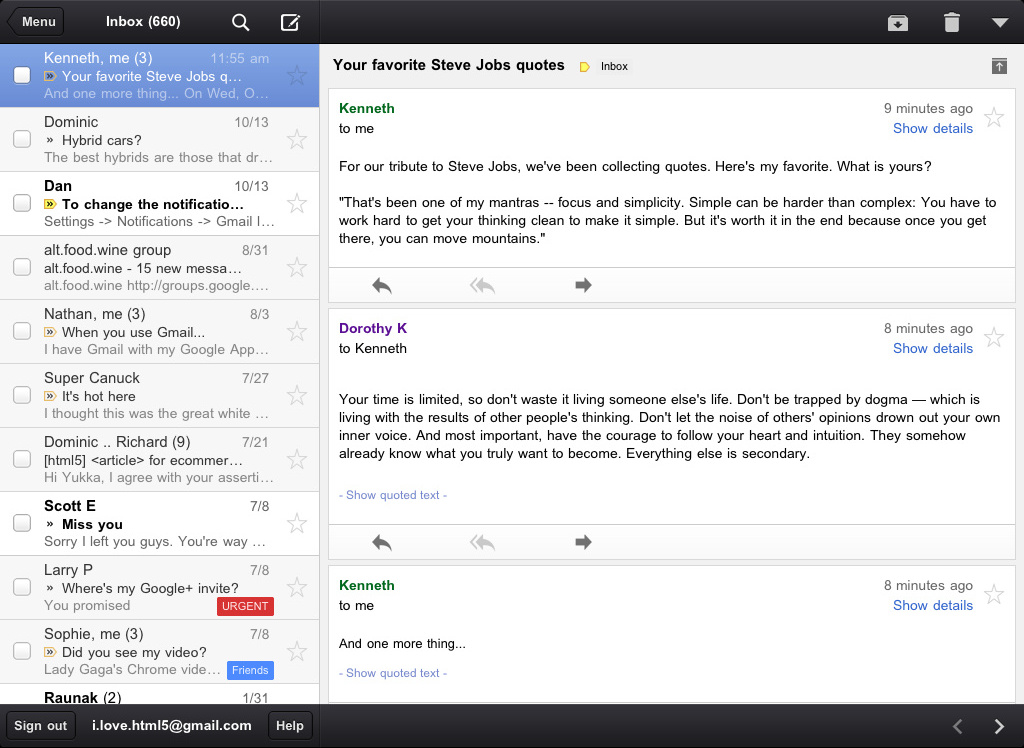
With that in mind, we’ve created a new Gmail app for iPhone, iPad, and iPod touch. We’ve combined your favorite features from the Gmail mobile web app and iOS into one app so you can be more productive on the go. It’s designed to be fast, efficient and take full advantage of the touchscreen and notification capabilities of your device. And it’s one more reason to switch to Gmail.

Speed
We want to give you the information you need quickly, with minimal effort and distraction. So we’ve included some time-saving features:

  • Get alerted to new messages with push notifications and sounds
  • Find an email in seconds with search across your entire inbox
  • Autocomplete email addresses from your Gmail contacts or select from your device’s address book
  • Upload photos with a click using the new attachment button in compose view
  • On iPad, navigate your inbox and read your mail simultaneously with split view


Upload photos
Reply, move, label and more


Efficiency
Our inboxes overflow with dozens and even hundreds of messages a day—and this can be even more challenging on a smaller screen. The new Gmail app helps organize your mail so you don’t have to go wading through your inbox to find that key message from your boss or loved one:

  • Focus on your important messages first with Priority Inbox
  • Quickly scan countless emails on the same subject with threaded conversations
  • Organize your mail by archiving, labelling, starring, deleting and reporting spam


Threaded conversations on the iPad


Touch
We’ve also optimized the interface so you can perform common actions in Gmail with the lightest touch:

  • Pull down your inbox to rapidly refresh if you’re eager for new mail
  • Swipe right to view your labels without ever leaving your inbox
  • Swiftly scroll through dozens of emails just by sliding your finger


Pull down to refresh
Swipe right to view labels

We hope the Gmail app makes checking email on the go a little easier. It is available in the App Store today and works on all devices running iOS 4+. For more information, check out our help center.

Update: 11/16/11 On 11/2 we launched a new Gmail app for iOS but after finding a bug removed the app from the App Store. Starting today, the Gmail app is now available again.

Tuesday, November 1, 2011

What's next for airline apps?

Delta Air Lines' app allows passengers to rebook in the event of a delayed or canceled flight.

Airline passengers are already able to check in to flights, download boarding passes, select a seat on the go and keep an eye on the upgrades list thanks to recent evolutions in smartphone technology, and the options just keep growing.
A global industrywide Airline IT Trends Survey shows that more than 90% of the airlines surveyed are increasing their investment in mobile capabilities to ease the hassles of getting through the airport and improve the in-flight experience. And the airlines are likely to find a way to generate revenue, too.

So what's a flier to expect from airline apps on the horizon? In the not-too-distant future, you'll probably be able to rent a car, pay bag fees and use augmented reality to find the nearest airport bar through your airline's smartphone app.
Delta Air Lines is putting emphasis on improving mobile functionality. While some airline apps allow travelers to make flight reservations (a feature that Delta has not introduced but promises is coming), the world's largest carrier is one of the few airlines that gives customers the ability to adjust travel itineraries from their mobile device.
Delayed Delta passengers who miss a connection now can immediately rebook a different flight and download a new boarding pass, all while in the air.
The airline has some new app plans up its sleeve as well. Delta declines to give a release date for the feature, but it is close to unveiling a new tool where travelers can track checked baggage from their mobile devices, according to Delta spokesman Paul Skrbec. (They can already do so on the airline's website.)
The airline eventually could offer other services on its mobile app that are already listed on its website, such as the ability to search for hotel and car rental reservations, Skrbec said.
GuestLogix, a company that creates onboard merchandising technology, is already trying to integrate these services into an airline app with the launch of its OnTouch Mobile Concierge platform, which it pitched to major airlines this week, a company official said. The mobile app does not just offer access to itinerary details, but it also functions as a one-stop shop for airline passengers to make in-air purchases related to their trip, such as in-flight refreshments and arrangements for ground transportation, dining and entertainment in the destination city.
GuestLogix says it is in talks with most major North American carriers about implementing the OnTouch Mobile Concierge, which would likely be offered by airlines as a separate app from the ticketing-based ones that exist.
"We are providing airlines with the opportunity to offer their passengers a streamlined experience," said Brett Proud, GuestLogix's executive vice president of new markets and products. "Disparity within the mobile channel is a huge issue despite the fact that consumers are increasingly expecting cross-platform integration and a consistent experience. The fully integrated mobile platform that we have built allows travelers to check in to flights and hotels, view travel information and updates, and receive offers from multiple airline carriers, hotels and other services -- all at one time, and in one place."
The hope is the OnTouch Mobile Concierge will also allow airlines to generate new revenue streams by capitalizing for the first time on destination-related purchases.
But integrating outside products and services into airline apps is not the only way that airlines hope to customize the passenger experience while increasing revenue. According to Delta's Skrbec, the demand is likely there for airlines eventually to offer add-ons such as standby upgrades and the ability to pay for extra checked baggage through mobile applications, but industry research suggests that offering those types of mobile transactions won't happen overnight.
According to a report released this year by Amadeus, a company that develops technology for the travel industry, ancillary services -- from premium seating to in-flight meals -- are unlikely to be sold on airlines' mobile platforms on a widespread level for another year or two.
So more add-ons and products will be available, but is help on the way for slogging through the airport?
American, United and Continental airlines currently offer airport maps in their mobile apps, with Delta soon to join them. But the maps are generally useful only in locating gates; they don't offer detailed information on where to find food and shopping locations.
Augmented reality technology may come to the rescue here. It allows users to point the camera on their smartphone at their surroundings and receive corresponding information about their current location, such as which restaurants and stores are nearby. Amadeus's report estimates it will take three to five years for most airlines to find a way to integrate augmented reality into an airline app.
Airlines might take some cues from a new app released by Denmark's Copenhagen Airport this year, which became the world's first application to use augmented reality indoors successfully -- according to SITA, the app's developer. The app allows travelers at the airport to access not just gate information but also details on surrounding shops and services, saving them time while trying to catch a flight.
Even when it comes to selling fares through mobile clients, a service that 85% of airlines in the Airline IT Trends Survey either offer or plan to offer by 2014, there is room for improvement. Currently, airline apps only offer tickets with their specific carrier, and mobile customers can't take advantage of the flexibility offered by airline alliances.
"Airline alliances, the Star Alliance in particular, haven't really kept pace with mobile developments," said Dennis Schaal, the North America editor of the travel tech site Tnooz.com. "Granted, creating a mobile app that brings in dozens of airlines would be no easy task, but there should be some kind of booking capability at this juncture."
The Star Alliance has two mobile apps available for download: one that offers airport information in addition to the ability to search and track flights, and another that is a fare finder for flights on the alliance's airlines. The Star Alliance includes airlines such as United, Continental, Air Canada and US Airways -- which does not currently offer a mobile app.
But those airlines that fail to take the full leap into the mobile world will quickly find themselves in the minority. Apps might not replace websites as the primary place where people purchase airline reservations, especially with new airline initiatives to integrate ticket-purchasing apps into social-media sites such as Facebook.
However, they're beginning to offer a level of customer service and convenience that has never before been possible in the industry, and perhaps could even transform the experience of traveling enough to create a new barometer on which airline brands will be judged in the future.

Don't sleep with your smart phone nearby

 
The urge to pull out your cell in the presence of a real person is a sign of addiction, says tech lecturer and author Daniel Sieberg.


Editor's note: CNN Contributor Bob Greene is a bestselling author whose books include "Late Edition: A Love Story" and "When We Get To Surf City: A Journey Through America in Pursuit of Rock and Roll, Friendship, and Dreams."

(CNN) -- "I won't even sleep in the same room with them."
A fellow named Daniel Sieberg was telling me his hard-and-fast rule for getting through the night.
He takes all of his digital devices -- laptops, tablets, cellphones, anything portable that has a screen -- to another room before he turns off the light. He has come to terms with the fact that the technological gadgets that have so thoroughly insinuated themselves into our lives can become addictive.
So, when it's time for slumber, he locks them out. He won't even let his cellphone charge overnight in the bedroom:
"If it's there, I would have the temptation to turn it on and check it."
We have learned to celebrate, even revere, the wireless gadgets we carry around and the inventors who bring them to us; the response to the death of Steve Jobs this month was emblematic of how important our do-it-all phones, our computers, our tablets and related digital devices have become. We say that the technology has changed life as we used to know it.
But how much is too much?
And, more to the point: How many of us have the nagging feeling that we are somehow unable to disconnect -- that the electronic devices we own have begun to own us?
There is an instinct to treat the subject whimsically: "Land o'Goshen, Ma, those kids are walking down the street staring at their cellphone screens." It's as if any criticism of what the digital age has done to society brands the person raising the questions as backward, afraid of change, irrationally wedded to outmoded ways.
So the addiction question is often one that people silently ask themselves. Shouldn't we be spending less time checking and rechecking our many screens, large and small, and more time taking part in what used to be regarded as real life? Is there something inherently wrong when people being separated from their phones, computers and tablets makes them feel nervous, irritable, tense -- in other words, when they begin to exhibit classic withdrawal symptoms?
For guidance on this, I got in touch with Sieberg, who has given as much thought to the subject as anyone of whom I'm aware. A former CNN correspondent, he is a lecturer, writer and broadcaster on technology issues who, in his own life, became increasingly conscious of the unhealthy hold that digital devices can have. He wrote a book called "The Digital Diet" that argues persuasively that there can come a time in a person's life when he or she is a good candidate for technology detox.
I asked him if "addiction" is too strong a word to use in relation to devices that seem to hook their users emotionally, but not chemically.
"Unfortunately, the word 'addiction' has become overused," he said, and should not be trivialized. Addictions to illegal drugs, alcohol and prescription medication are grimly somber matters. But, he said, the idea of an addiction to digital devices is genuine and is not something that should be greeted with a sardonic wink.
"One definition of 'addiction' is when other people and other activities in your life begin to suffer because of something you know you should cut back on, but don't," he said.
Some of his examples are things that many people will instantly recognize:
-- The urge to pull out a cellphone even when someone you're with is in the midst of a conversation with you.
-- Texting even while your child is telling you about his or her day at school, and realizing later that you can't remember the details of what your son or daughter has said to you.
-- Having the vague feeling that something hasn't really happened until you post it to Facebook or Twitter.
-- Feeling isolated and anxious if you are offline for an extended period of time.
-- Noticing that even when your family is all together in one room at home, each person is gazing at his or her own screen and tapping at a miniature keyboard.
"There are people who, even when they aren't using their digital devices, find themselves creating status updates or Twitter feeds in their heads while they are experiencing things," he said. "It's as if they have lost the ability to live in the moment, and have become conditioned to feeling that they have to instantly share it electronically while it is still going on."
Sieberg is hardly a guy stuck in some dust-covered, pre-technology past: He has always been among the first to own each new portable device, and he likes the many good things the digital experience can provide. But he realized -- when his wife would wake up in the middle of the night to see him, in bed, illuminated by the glow of one screen or another that he had decided to check one more time before he fell back asleep -- that something might need remedying.
There is, he said, a feeling common among people who are digitally hooked that, when it's just them and the real world and no screen, they are somehow cast adrift, cut off: "It's a sense of, 'What am I missing?'" But in truth, a strong case can be made that when a person lives too many hours a day in the digital universe, that is when he or she is really missing something -- missing the things that are taking place in the flesh-and-blood world.
Sieberg has a phrase for it: You know you're in trouble when "your footing in technology feels increasingly like quicksand."
And he has a piece of advice for all of us, regardless of how deep we feel we're sinking into that digital quicksand:
Like him, we should consider locking all of those devices in another room at night. He promises that it makes a difference:
"You sleep better."